A Workshop Needs More Than a Room With Chairs
If attendees spend the first part of a workshop watching a presentation and the next part trying to collaborate at tables that do not support discussion, the room is working against the agenda.
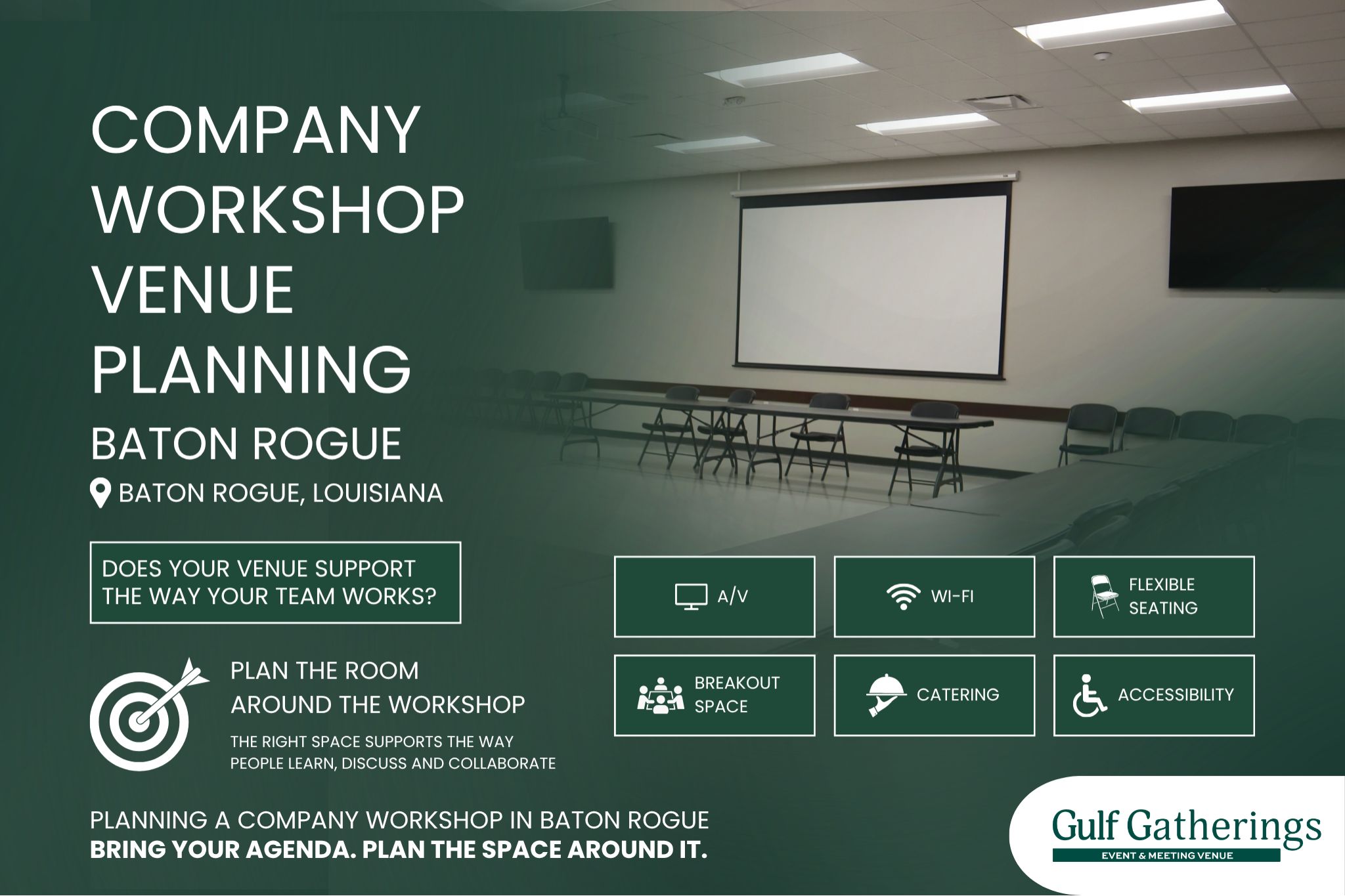
Choosing a workshop venue in Baton Rouge means planning for both instruction and participation. Organizers should evaluate seating, writing space, facilitator visibility, A/V, Wi-Fi, breakout discussions, registration, catering breaks, parking, accessibility, supplies, and any room changes needed during the session. A workshop is different from a standard meeting because attendees are expected to do more than listen or make decisions. They may need to write, discuss, solve problems, practice skills, or produce work together.
Start With What Participants Will Actually Do
Before selecting a room arrangement, break the workshop agenda into activities.
Ask:
- When will attendees listen to the facilitator?
- When will they need a table or writing surface?
- Will they work independently, in pairs, or in groups?
- Will groups report back to everyone?
- Will participants use laptops or online tools?
- When will food and breaks occur?
- Does the facilitator need to move around the room?
This gives you a better starting point than choosing a layout based only on appearance.
Gulf Gatherings currently promotes customizable event layouts, high-speed Wi-Fi, integrated A/V, tables and chairs, setup support, and parking for professional gatherings. Organizers can review the venue’s Baton Rouge event venue amenities while deciding which features their agenda actually requires.
Classroom or U-Shaped Seating: Which Fits the Workshop?
The layout should match the level of interaction.
Classroom-Style Seating
Classroom seating generally works well when participants need:
- Writing space
- Laptops
- Handouts
- A clear view of the presenter
- Extended periods of instruction
It keeps attention directed toward the front while giving participants a work surface.
U-Shaped Seating
A U-shaped arrangement may work better when discussion is a major part of the workshop because attendees can more easily see the facilitator and one another.
Cvent’s event seating guide identifies classroom seating as useful for workshops and training sessions and horseshoe or U-shaped seating as suitable for presentations combined with collaborative discussion.
Do not assume either configuration will automatically fit your attendance and equipment. During a venue tour, discuss the agenda and ask how the room could be arranged. Gulf Gatherings’ existing event venue floor plan guide also explains how seating, registration, food service, A/V, and circulation affect the overall room plan.
Plan Breakout Discussions Without Losing the Main Session
A workshop often shifts between full-group instruction and smaller conversations.
That does not always mean you need separate breakout rooms. Depending on the workshop format and available space, smaller discussion groups may be able to work in designated areas within the main room.
Before booking a business workshop venue, determine:
- How many groups will work at the same time
- Whether discussions need privacy
- Whether tables need to support shared materials
- How participants will move into and out of groups
- How the facilitator will regain everyone’s attention
- Whether furniture needs to change between activities
If the agenda requires a room reset, confirm in advance whether that transition is practical and who will be responsible for it. Setup and teardown are listed among Gulf Gatherings’ current venue offerings, but a mid-event room reset should be discussed separately rather than assumed. Gulf Gatherings
Protect Presentation Visibility and A/V Before the Workshop Starts
A collaborative workshop still needs a clear focal point.
Place the facilitator and presentation area where attendees can see them from the primary seating arrangement. If groups later move around the room, consider whether everyone can return quickly to the main presentation.
Gulf Gatherings currently lists high-speed Wi-Fi and integrated A/V among its amenities. Gulf Gatherings Before the event, organizers should still confirm equipment availability, device connections, audio requirements, file compatibility, internet needs, and who will operate the equipment.
For a professional workshop, test presentations before attendees arrive instead of discovering a connection issue during the opening session.
Already building your workshop agenda? Bring the schedule, expected attendance, presentation requirements, breakout format, and catering plan to a Gulf Gatherings venue tour. Reviewing those pieces together can help you determine whether the room setup supports the way participants will actually work.
Keep Registration, Parking, and Accessibility in the Plan
The workshop experience begins before the first slide.
Registration should be easy to find without blocking the main entrance or the path to seating. If participants receive name badges, workbooks, supplies, or folders, allow enough check-in space to distribute those materials efficiently.
Gulf Gatherings currently lists professional guest check-in, parking, custom floor layouts, Wi-Fi, and A/V access among its event features.
Accessibility should also be considered during the first version of the room plan. Consider parking, entrances, clear circulation routes, seating, access to food service, and presentation visibility.
The U.S. Access Board’s guidance on accessible routes explains how accessible routes connect spaces and building elements. Use this type of guidance when planning access, but confirm the specific venue conditions rather than making assumptions about legal compliance.
Schedule Catering Around Participation
Food should support the workshop schedule rather than interrupt it.
If a group is in the middle of an exercise, opening a buffet at the same time can split attention. Likewise, serving a meal immediately before a critical presentation may force the facilitator to rush the transition.
A practical schedule may separate:
- Arrival and registration
- Opening presentation
- First working session
- Break
- Second collaborative session
- Meal service
- Final workshop activity
- Group report-back or wrap-up
Gulf Gatherings offers on-site catering and currently describes options ranging from box lunches to hot buffets. Gulf Gatherings Review the venue’s on-site event catering options and discuss menu choices, dietary requests, service timing, and pricing directly with the team.
Decide Who Supplies Workshop Materials
The venue and the workshop facilitator have different responsibilities.
Create a supply list before event day that may include:
- Participant workbooks
- Pens
- Printed exercises
- Name badges
- Laptops or tablets
- Chargers
- Facilitator materials
- Activity supplies
Do not assume the venue provides workshop supplies, whiteboards, specialty equipment, adapters, or printing unless those items have been specifically confirmed.
This is also a useful reason to distinguish a workshop from a simple meeting. The room must support the work being performed, not just provide a place to sit.
A Practical Workshop Scenario
Consider a Baton Rouge company planning a half-day process workshop involving several departments.
The session begins with a presentation, shifts into small-group problem solving, pauses for a meal, and ends with each group discussing its recommendations.
For that event, the organizer would need to think through presentation sightlines, table space for worksheets and laptops, group movement, meal timing, Wi-Fi, parking, registration, and whether the original seating arrangement still works during the collaborative portion.
A standard conference room may be sufficient for a simple discussion, but a workshop with multiple activities can require more flexibility. Gulf Gatherings’ conference room versus event venue guide discusses the differences between basic meeting spaces and venues designed to support more complex professional gatherings.
Baton Rouge also offers a wide range of professional meeting spaces and planning resources, which means organizers can compare venues around the actual agenda rather than settling for a generic room. Visit Baton Rouge provides an official meetings and venue planning resource for organizations evaluating local options.
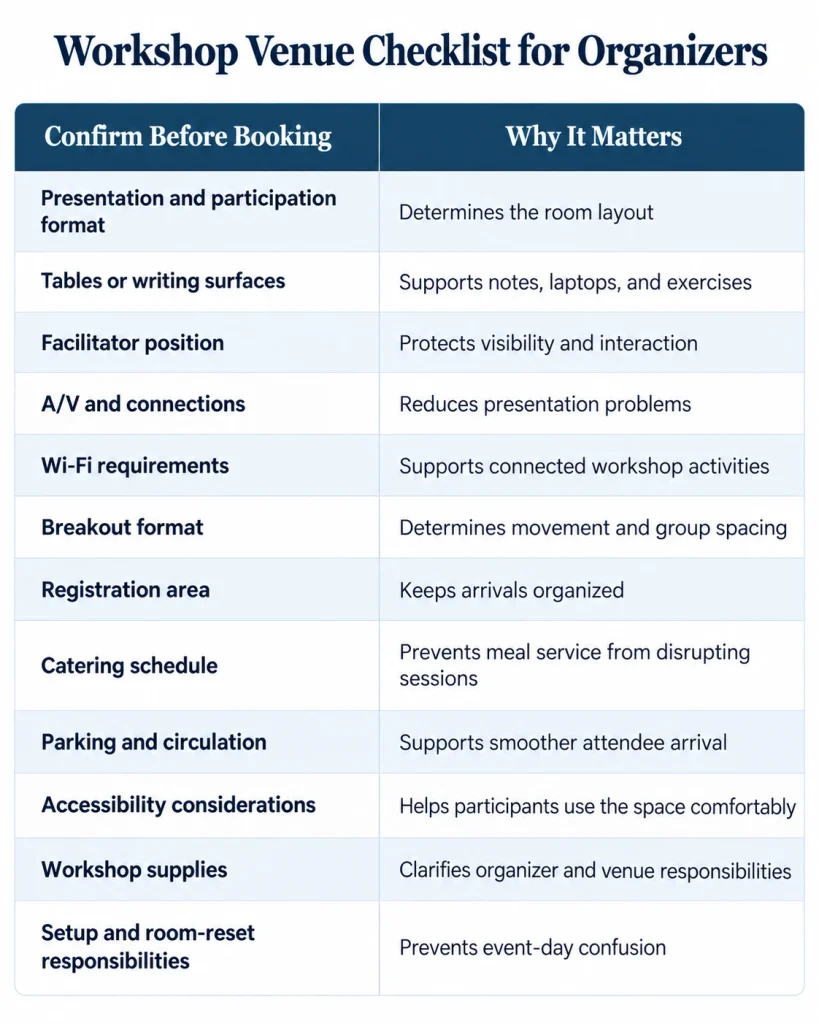
Workshop Venue Checklist for Organizers
Turn Your Workshop Agenda Into a Venue Plan
The right workshop venue in Baton Rouge should support both sides of the session: the information participants need to receive and the work they need to complete.
Before making a final venue decision, bring your agenda, attendance estimate, preferred seating format, breakout plan, catering schedule, supply list, and technology requirements to the venue discussion.
Gulf Gatherings combines customizable layouts with verified amenities that include tables and chairs, A/V, Wi-Fi, parking, setup and teardown, guest check-in, and on-site catering. Gulf Gatherings
When you are ready to compare your workshop requirements with the actual space, schedule a Gulf Gatherings venue discussion or tour before finalizing the room plan.
FAQs
What should I look for in a workshop venue in Baton Rouge?
Look for a space that can support presentations and active participation. Compare layouts, writing surfaces, A/V, Wi-Fi, breakout flow, registration, catering, parking, accessibility considerations, setup, and any room changes your agenda may require.
Is classroom or U-shaped seating better for a company workshop?
Classroom seating is useful when attendees need writing surfaces and sustained focus on a presenter. A U-shaped layout can support more face-to-face discussion. Choose based on the activities in the workshop rather than using one layout for the entire agenda automatically.
How is a workshop different from a standard business meeting?
A standard meeting may focus primarily on discussion, updates, or decisions. A workshop typically asks participants to complete exercises, collaborate, practice, or produce something, which can create additional requirements for tables, movement, supplies, technology, and room flexibility.
Should catering be scheduled during a workshop?
Yes, but schedule food around the workshop flow. Breaks and meals should complement the agenda rather than interrupt exercises or presentations. Discuss service timing and menu requirements with the venue before the event.